
A spilled glass of red wine, a splash of cooking oil, a forgotten coffee ring-these are the moments that can cause any homeowner to panic. You invested in stunning, durable granite countertops to elevate your kitchen, and the thought of a permanent stain is enough to cause real concern. Protecting that investment is crucial, but navigating the world of sealants can be confusing. Finding the best granite sealer feels like a challenge when you’re faced with technical terms and hundreds of products all claiming to be number one.
This guide is designed to give you complete confidence. We will walk you through everything you need to know, from determining if your specific granite needs sealing to understanding the difference between penetrating and topical products. You’ll learn how to choose a high-quality, food-safe sealer and apply it for a flawless finish. Consider this your complete resource for keeping your countertops protected and looking as beautiful as the day they were installed for years to come.
Key Takeaways
- Perform a simple 5-minute water test to quickly determine if your granite countertops are properly sealed and protected.
- Understand the key differences between sealer types to ensure you choose a product that offers durable, long-lasting results.
- Use our 4-point checklist to confidently select the best granite sealer for your needs, guaranteeing a premium, food-safe finish.
- Follow our step-by-step professional method to apply sealer flawlessly, protecting your investment from stains and daily wear.
Why Sealing Granite Countertops is a Non-Negotiable Investment
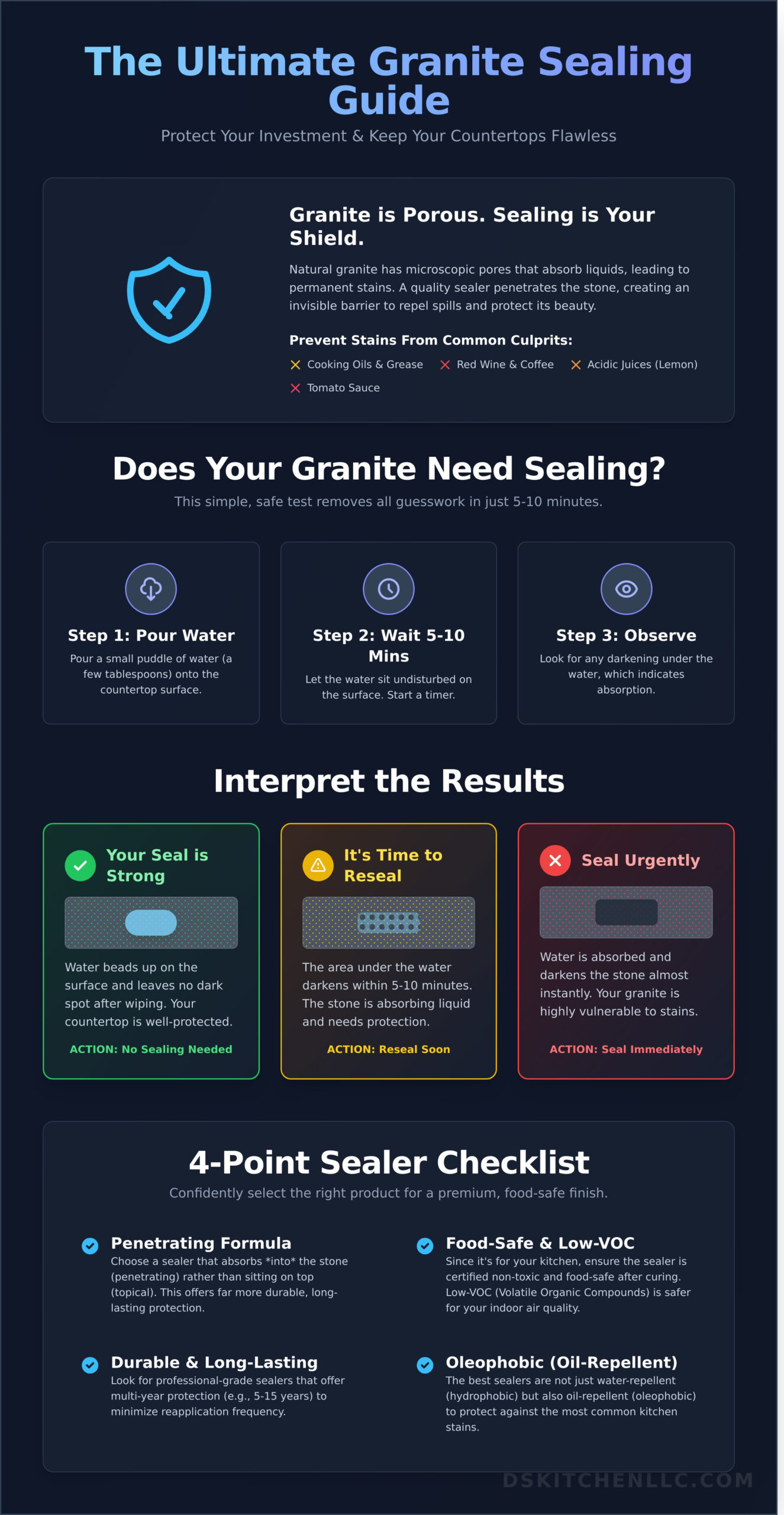
You chose granite for its stunning, one-of-a-kind beauty and exceptional durability. But to protect that premium investment, there’s one step you can’t afford to skip: proper sealing. As a natural stone, granite is porous. Think of its surface like a very dense, high-quality sponge, full of microscopic pores that can absorb liquids. Without a protective barrier, everyday spills can seep into the stone, leading to permanent stains and discoloration that mar its flawless appearance.
To see how a professional application protects your stone, this video provides a helpful overview:
The primary purpose of a granite sealer is to penetrate the stone and fill these tiny pores. This creates an invisible shield that repels liquids, giving you crucial time to clean up spills before they can cause damage. Ultimately, sealing is what preserves the beauty and longevity of your countertops for years to come.
This concept of proactive maintenance to ensure longevity applies to many valuable assets. Just as stone needs the right sealant, a complex diesel engine needs expert service to protect the investment. For vehicle owners seeking that level of care, you can discover Diego’s Shop for specialized, warrantied repairs.
The Science Behind Granite’s Porosity
Granite is an igneous rock formed from cooled magma, composed of interlocking mineral crystals like quartz and feldspar. The microscopic gaps between these crystals create natural porosity. If you want to dive deeper into its formation, you can explore this resource on What is Granite?. The density and size of these pores vary significantly between different types of granite, which is why some slabs are more absorbent and prone to staining than others. Lighter-colored stones, for instance, often have higher porosity.
Common Culprits: The Stains You Want to Prevent
Applying the best granite sealer for your specific stone creates a crucial barrier against the daily hazards of a busy kitchen. It provides robust protection from common liquids that can cause deep, unsightly stains, such as:
- Cooking oils and grease
- Red wine, coffee, and tea
- Acidic fruit juices like lemon or berry
- Tomato sauce and other colorful foods
Beyond preventing stains, sealing also promotes a more hygienic surface. By blocking the pores, it helps prevent bacteria and other germs from harboring within the stone, making your countertops easier to clean and safer for food preparation.
Does Your Granite Need Sealing? The Simple 5-Minute Water Test
Your stunning granite countertops are a major investment and the centerpiece of your kitchen. But how do you know when it’s time to protect that investment with a new coat of sealer? Guesswork can lead to either unnecessary work or, worse, permanent stains. Fortunately, there’s a foolproof method that takes just five minutes.
Before you start searching for the best granite sealer, it’s crucial to know if your countertops actually need it. This simple, safe water test removes all uncertainty, giving you a clear answer. We recommend performing this check even on newly installed granite, as the effectiveness of factory seals can vary depending on the stone’s natural porosity.
How to Perform the Water Test: Step-by-Step
This test is completely safe for your stone and requires nothing more than a little water and a few minutes of your time. Follow these simple steps:
- Step 1: Pour a small puddle of water, about the size of a coaster (a few tablespoons), onto a section of your countertop. For the most accurate reading, test a few different areas, especially high-use zones near the sink or stove.
- Step 2: Start a timer. Let the water sit undisturbed on the surface for approximately 5 to 10 minutes.
- Step 3: Closely observe the area. Look to see if the granite under the water puddle begins to darken, which indicates that the stone is absorbing the liquid.
Interpreting the Results
The outcome of your test will tell you everything you need to know about the state of your granite’s seal. Here’s how to read the results:
- Your Seal is Strong: The water beads up and remains on the surface without leaving any dark spot after you wipe it away. Your countertops are well-protected.
- It’s Time to Reseal: The area under the water darkens within 5-10 minutes. This means the granite is starting to absorb liquids, and it’s time to apply a high-quality sealer to restore protection.
- Seal Urgently: The water is absorbed and darkens the stone almost instantly. Your granite is porous and vulnerable to stains. Sealing should be a top priority.
How Often Should You Test Your Granite?
As a rule of thumb, performing this water test once a year is a great way to stay ahead of maintenance. For high-traffic areas-like the space around your sink or your primary food prep zone-we recommend testing every six months. While our premium granite countertops are always expertly sealed upon installation for day-one protection, this simple check-up ensures they maintain their flawless beauty for years to come. This test will tell you exactly when it’s time to find and apply the best granite sealer to keep your investment safe.
Types of Granite Sealers Explained for Homeowners
When you invest in stunning granite countertops, protecting that investment is the next crucial step. However, a quick look at the options reveals that not all sealers are created equal. Understanding the fundamental differences between products will empower you to read labels with confidence and choose the right protection for your kitchen. The best granite sealer for your home is one that matches your stone’s needs and your application comfort level.
To simplify your choice, sealers are typically categorized in two main ways: how they protect the stone and what liquid carries the sealing agent.
Penetrating (Impregnating) Sealers vs. Topical Sealers
This is the most important distinction for any homeowner. The way a sealer protects your granite directly impacts its look, feel, and long-term durability in a busy kitchen environment.
- Penetrating Sealers: As the name suggests, these formulas absorb deep into the pores of the granite. They work from within to form a protective, stain-repellent barrier without altering the stone’s natural finish or texture. This is the professional standard for a flawless, functional kitchen.
- Topical Sealers: These products form a protective film on top of the granite. While they might add a high-gloss shine initially, this coating is prone to scratching, peeling, and yellowing. They are not recommended for food preparation surfaces as they can trap moisture and look artificial.
For a premium surface like granite, a penetrating sealer is always the superior choice to preserve its authentic beauty and ensure lasting, food-safe protection.
Water-Based vs. Solvent-Based Sealers
This second category refers to the liquid carrier that delivers the protective polymers into the stone. Both can be effective, but they offer very different application experiences.
- Water-Based Sealers: A modern, homeowner-friendly option. These formulas use water as the carrier, resulting in very low odor and low VOCs (volatile organic compounds). Cleanup is simple with just soap and water, making them ideal for a DIY project.
- Solvent-Based Sealers: The traditional choice for professionals. These use a petroleum-based carrier to achieve deep penetration. Their main drawback is a powerful chemical smell and the need for excellent ventilation and more intensive cleanup with mineral spirits.
While solvent-based sealers have a long history, today’s advanced water-based formulas offer exceptional performance and durability, providing a safer and more pleasant application experience without compromising on protection.
How to Choose the Best Granite Sealer: A 4-Point Checklist
Selecting the right sealer is just as important as choosing your stunning granite slab. To protect your investment and keep your countertops looking flawless for years to come, you need a product built for the demands of a modern kitchen. This straightforward checklist will guide you through the key features to look for when choosing the best granite sealer for your home.
1. Look for a Penetrating (Impregnating) Formula
The highest quality sealers are penetrating, also known as impregnating. Unlike topical sealers that sit on the surface and can create a plastic-like film, a penetrating formula absorbs deep into the granite’s pores. This creates a durable, breathable barrier from within, protecting against stains without altering the stone’s natural texture or stunning appearance. It’s the professional’s choice for long-lasting, invisible protection.
2. Prioritize Food-Safe and Low-VOC Options
Your kitchen is the heart of your home, and safety is non-negotiable. Always choose a sealer that is explicitly labeled as food-safe or food-grade. This ensures it’s safe for incidental food contact once fully cured. Additionally, look for a low-VOC (Volatile Organic Compounds) formula. VOCs are chemicals that can be released into the air, affecting indoor air quality. A low-VOC sealer is a healthier choice for your family and your home environment.
3. Check for Oleophobic (Oil-Repellent) Properties
Many sealers are hydrophobic, meaning they repel water. But in a kitchen, you need more than that. A premium sealer will also be oleophobic, meaning it repels oil-based substances. This is a critical feature for protecting against common kitchen spills like cooking oil, grease, and salad dressing, which can cause deep, difficult-to-remove stains. This oil-repellency is a key differentiator between a standard sealer and a high-performance product.
4. Consider Longevity and Reapplication
Be wary of products claiming “lifetime” or “20-year” protection with a single application. While premium sealers are incredibly durable, a busy kitchen countertop endures daily wear. For optimal performance, we recommend a high-quality sealer that suggests reapplication every 1-3 years. This realistic schedule ensures your granite remains fully protected against stains and etching. For more expert advice on stone care, check out the other articles on our blog.
How to Apply Granite Sealer: A Step-by-Step Professional Method
Choosing the right product is the first step, but achieving a flawless, durable finish depends entirely on proper application. Even the best granite sealer won’t perform correctly if it isn’t applied with care. This professional, three-stage method is designed to give you a stunning, long-lasting result that protects your investment.
A Quick Note on Safety: Before you begin, ensure your kitchen is well-ventilated by opening windows and using fans. Most sealers have strong fumes, so wearing gloves and eye protection is highly recommended.
Step 1: Prepare the Surface
A pristine surface is non-negotiable for proper sealer absorption. Any dirt or residue left on the stone will be trapped under the sealer, so don’t rush this step. For a perfect start:
- Thoroughly clean your countertops with a pH-neutral stone cleaner and a microfiber cloth.
- Allow the granite to dry completely. We recommend waiting at least 24 hours to ensure all moisture has evaporated from the stone’s pores.
- Use painter’s tape to protect your sink, faucets, cooktop, and backsplash from the sealer.
Step 2: Apply the Sealer Evenly
With your surface prepped, you’re ready to apply the sealer. Work in small, manageable sections (e.g., three to four square feet at a time) to maintain control. Apply a thin, even layer of your granite sealer with a clean, lint-free microfiber cloth. The goal is to wet the surface without oversaturating it. Let the sealer sit and penetrate the stone for the time specified by the manufacturer, which is typically between 5 and 15 minutes.
Step 3: Remove Excess and Cure
This is the most critical part of the process. After the sealer has had time to penetrate, you must thoroughly wipe off all excess product from the surface using a fresh, dry microfiber cloth. Any sealer left to dry on the surface will not absorb further and will instead cure into a hazy, streaky film that is difficult to remove. Once all excess is removed, allow the countertops to cure for 24-48 hours before exposing them to liquids or cleaning products.
Feeling Overwhelmed? When to Call a Pro
A DIY sealing project can be rewarding, but it isn’t for everyone. If you’re concerned about achieving a perfect finish or simply don’t have the time, professional application is an excellent choice. An expert ensures the job is done flawlessly, using premium products to protect your beautiful granite countertops. If you want guaranteed results, contact our Tampa-based experts for professional advice and service.
Your Guide to a Flawless, Lasting Finish
Protecting your granite is one of the smartest investments you can make in your home. As we’ve covered, understanding your stone’s unique needs with a simple water test is the crucial first step. This knowledge empowers you to select the best granite sealer and apply it using a professional method, ensuring a durable, stunning finish that resists stains and daily wear. Proper sealing isn’t just maintenance; it’s the key to preserving the timeless beauty of your countertops for years to come.
Of course, a flawless finish begins with premium stone. If you’re dreaming of a kitchen upgrade, trust the experts who have proudly served Tampa for over 10 years. At D&S Kitchen LLC, our A+ rating for customer service reflects our commitment to quality, and we guarantee every installation features premium, professionally sealed granite built to last. Considering new granite countertops? Explore our premium selection and let us help you build the stunning kitchen you’ve always envisioned.
Frequently Asked Questions About Granite Sealers
How often do I really need to seal my granite countertops?
The ideal frequency for sealing depends on your granite’s porosity and daily use. As a general guideline, we recommend resealing every 1-3 years. The best way to check is with a simple water test: leave a few drops of water on the surface for 15 minutes. If the stone darkens, it’s absorbing the water and is ready for a fresh coat of sealer. This ensures your stunning countertops maintain their flawless protection against spills.
Will sealing my granite make it look shiny or change its color?
A high-quality impregnating sealer is designed to be virtually invisible. It works by penetrating the stone’s pores rather than coating the top, so it will not alter the color or add a glossy finish to your honed or polished granite. While some “enhancing” sealers exist to darken the stone, a standard premium sealer will preserve the natural, stunning beauty of your countertops without changing their original appearance, ensuring a finish that is built to last.
What happens if I don’t seal my granite countertops?
Because granite is a natural, porous stone, failing to seal it leaves it vulnerable to stains. Common kitchen liquids like oil, wine, juice, and coffee can seep into the pores, causing permanent discoloration and compromising the stone’s appearance. Regular sealing provides an essential, durable barrier that protects your investment, ensuring your countertops remain as beautiful and functional as the day they were expertly installed in your home.
Can I use a combination ‘cleaner and sealer’ product?
Combination cleaner and sealer products are excellent for routine maintenance, but they are not a substitute for a dedicated sealer application. These products help reinforce an existing seal during daily cleaning, extending its life. However, for the most robust and long-lasting protection, you should always start with an application of a high-quality, dedicated granite sealer. This provides the foundational defense your premium countertops deserve.
Is it possible to put too much sealer on granite?
Yes, over-application is a common mistake. Granite can only absorb a finite amount of sealer. If excess product is left to dry on the surface instead of being wiped away, it will create a hazy, streaky film that dulls the stone’s natural beauty. It is crucial to follow the product’s instructions carefully, applying a thin coat and thoroughly buffing off all residue to achieve a flawless, professional-grade finish without any cloudiness.
How do I remove an old or hazy sealer from my granite?
To remove a hazy film from over-sealing, you will need a specialty sealer and residue remover. These products are formulated to dissolve the old sealer buildup without damaging the granite itself. Apply the remover as directed, let it sit for the recommended time, and gently scrub with a non-abrasive pad. Once the surface is completely clean and dry, you can apply a fresh, thin coat of the best granite sealer for a crystal-clear, protective finish. For more complex restoration challenges or stubborn damage, you can visit The Solution to see what professional stone repair services can achieve.