
Choosing the perfect countertop for your home is one of the most important decisions in a kitchen or bathroom remodel. It’s a significant investment, and the fear of making a costly mistake can be paralyzing, especially when faced with two popular and stunning options. The Corian vs quartz debate is a common one for homeowners because both materials promise a premium, flawless finish. But how do they truly stack up in a busy, real-world household? Understanding the fundamental differences is the key to selecting a surface you’ll love for years to come.
At D&S Kitchen, we believe your home should be built around you. That’s why we’ve created this ultimate comparison guide to cut through the confusion. We’re here to give you a clear, side-by-side look at Corian and quartz, examining everything from cost and durability to style and long-term maintenance. By the end of this article, you’ll have the expert knowledge and confidence to choose the perfect countertop that fits your budget, complements your lifestyle, and truly elevates your home.
Key Takeaways
- Understand how the core difference between solid surface and engineered stone directly impacts your countertop’s daily performance and look.
- Discover which material holds up better against the top three kitchen threats—heat, scratches, and stains—for a stunning, durable surface.
- Get a clear financial breakdown in the corian vs quartz comparison to see which option delivers the best long-term value for your investment.
- Identify the right countertop for your home by matching your lifestyle and design goals to our ideal buyer profiles for each material.
What Are Corian and Quartz? Understanding the Core Materials
When choosing the perfect countertop, the debate between corian vs quartz often comes down to understanding their fundamental differences. One is a versatile solid surface, and the other is a durable engineered stone. While both offer a premium, high-quality finish for your kitchen or bathroom, their core composition directly impacts their performance, feel, and long-term durability. Knowing what they’re made of is the first step to making a confident investment built around your lifestyle.
To see a visual breakdown of these materials, this helpful video offers a clear comparison:
Here is a simple at-a-glance look at their core differences:
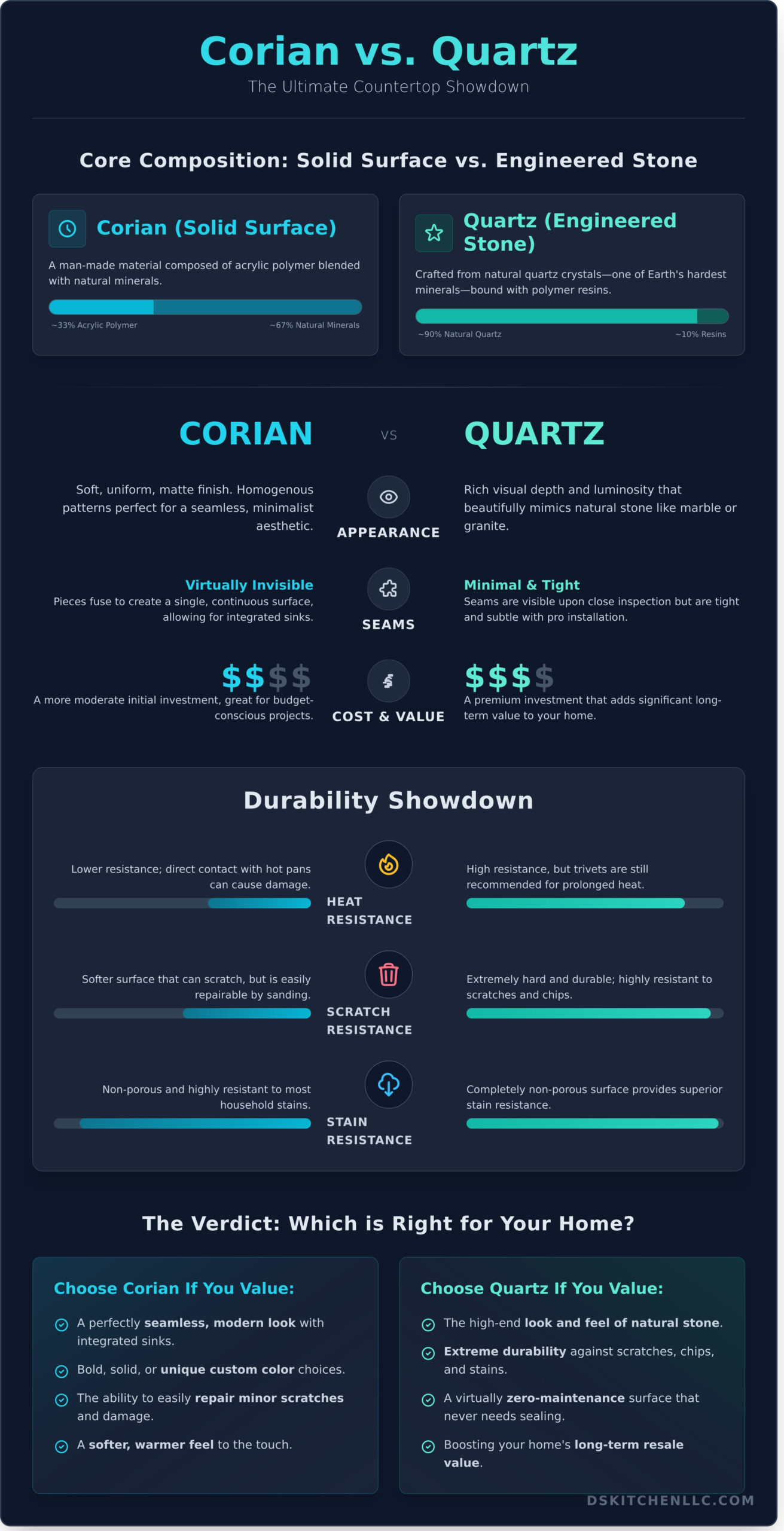
- Corian (Solid Surface): Composed of acrylic polymer and natural minerals. Its key feature is a seamless, uniform appearance with a soft, warm feel.
- Quartz (Engineered Stone): Made from ~90% natural quartz crystals and resins. Its key feature is extreme durability and the look of natural stone with a hard, cool feel.
Corian: The Seamless Solid Surface
Originally developed by DuPont, Corian is the brand that defined the solid surface category. This man-made material is composed of acrylic polymer and natural minerals, creating a completely non-porous surface. Its greatest strength lies in its workability; pieces of the Corian solid surface material can be joined with a special adhesive to create invisible seams. This allows for stunning, custom designs, including fully integrated sinks that flow seamlessly from the countertop. It has a noticeably softer and warmer feel compared to stone, offering a unique matte finish.
Quartz: The Durable Engineered Stone
Quartz countertops are a premium engineered stone, expertly crafted from approximately 90% natural quartz crystals—one of earth’s hardest minerals—blended with polymer resins and pigments. This manufacturing process creates an incredibly dense and durable slab that is highly resistant to scratches, chips, and stains. Unlike natural stone, quartz is non-porous and never needs to be sealed, making it a low-maintenance and hygienic choice for busy households. Its versatility allows it to mimic the stunning look of natural marble or granite while providing superior consistency and strength.
Appearance & Design: A Head-to-Head Style Comparison
Choosing a new countertop is one of the most exciting parts of a kitchen remodel, and aesthetics are a primary driver of that decision. The look and feel of your work surface sets the tone for the entire space. When it comes to corian vs quartz, each material offers a distinct visual identity that can elevate your home, but in very different ways. Understanding these differences is key to finding the perfect match for your design vision.
Depth, Luster, and Patterns
Quartz delivers a stunning visual depth that solid surface materials can’t replicate. Made from approximately 93% natural quartz crystals mixed with resins, it has a luminosity and richness that beautifully mimics natural stone. This allows for incredibly realistic marble-like veining and granite-style flecks, offering a premium, high-end look. In contrast, Corian provides a softer, more uniform appearance with a consistent matte or soft satin finish. Its patterns are homogenous, which is perfect for a minimalist aesthetic but lacks the organic character found in quartz.
Color Possibilities
Both materials offer an impressive palette, but they excel in different areas. Corian is renowned for its ability to be produced in vibrant, solid, and bold colors that are difficult to achieve in stone-based surfaces. If you’re dreaming of a bright white, a bold primary color, or a unique custom shade, Corian is a fantastic choice. Quartz, on the other hand, provides a wider and more sophisticated range of natural, stone-like tones, from subtle earth tones to dramatic, dark hues with intricate patterns. Explore our countertop options to see the incredible variety available for your project.
The Battle of the Seams
Here lies one of the most significant visual distinctions. Corian’s greatest aesthetic advantage is its ability to create virtually invisible seams. Pieces can be fused together and sanded to create a single, continuous surface. This allows for stunning integrated sinks and long, seamless countertop runs for a flawlessly clean look. While quartz seams are not invisible, a premium installation by a skilled craftsman makes them minimal and very difficult to spot. The ongoing discussion about Corian vs quartz countertops often highlights this difference, as the seamless look of Corian appeals to modern design, while the near-invisible seams of quartz are perfectly acceptable for most homeowners seeking a natural stone appearance.
Durability & Maintenance: Which Withstands a Busy Kitchen?
For a busy Florida family, a kitchen countertop is more than a surface—it’s the hub of daily life. It needs to handle hot pans, hurried meal prep, and the occasional spilled drink without showing wear. When considering corian vs quartz, performance under pressure is paramount. As detailed in this comprehensive Corian vs. Quartz comparison from home service experts, how these materials handle daily stress is a critical factor. Let’s break down their performance against the three biggest kitchen enemies: heat, scratches, and stains.
Heat Resistance: Handling the Heat
In an active kitchen, hot pots and pans are a constant. Quartz, engineered with natural stone crystals, is highly heat-resistant and can handle brief contact with hot items. However, it is not heat-proof, and extreme or prolonged heat can damage the resin binders. We always recommend using trivets as a best practice. Corian is far more sensitive to heat. Placing a hot pan directly on its solid surface can cause permanent scorching, discoloration, or even cracking, making quartz the clear winner for serious home cooks.
Scratch & Impact Resistance: Built for Daily Life
Your countertops should be a functional work surface, not a delicate showpiece. This is where the core difference between corian vs quartz becomes obvious.
- Quartz: As one of the hardest countertop materials available, quartz is exceptionally difficult to scratch or chip. It stands up beautifully to daily use, from sliding mixing bowls to dropped utensils, maintaining its flawless finish for years.
- Corian: As a softer, acrylic-based material, Corian is more prone to fine scratches from knives, abrasive pads, or even ceramic dishes. Heavy impacts can also leave dents or gouges that detract from its seamless look.
Stain Resistance & Cleaning: Effortless Upkeep
Both quartz and Corian are non-porous, which is a significant advantage for any kitchen. This quality means they do not absorb liquids, making them highly resistant to stains from coffee, wine, and oils. It also makes them incredibly hygienic, as they won’t harbor bacteria or mold like some natural stones can. Daily cleaning for both is simple and requires only a soft cloth with mild soap and water. While quartz is harder to damage, a unique benefit of Corian is its repairability; a professional can often buff out light scratches to restore its original, smooth appearance.
Cost vs. Long-Term Value: Analyzing Your Investment
A kitchen or bathroom remodel is a significant investment in your home, and your countertop choice plays a major role in the final budget. While the initial price tag is important, a truly smart decision balances upfront costs with long-term performance and its impact on your home’s overall value. Understanding the financial differences in the corian vs quartz debate is key to making a choice you’ll be happy with for years to come.
Upfront Installation Costs
When comparing initial price points, Corian is the more budget-friendly option. However, premium quartz offers a level of luxury and durability that many homeowners find justifies the higher cost. Here is a general breakdown of what you can expect:
- Corian: A solid mid-range choice, typically installed for $45 to $70 per square foot.
- Quartz: Considered a premium material, with installed costs ranging from $60 to over $100 per square foot.
Keep in mind that factors like brand, color complexity, and custom edge details will influence the final price for both materials.
Impact on Home Resale Value
For homeowners focused on return on investment, this is where quartz truly shines. Real estate professionals and potential buyers consistently view quartz countertops as a high-end, desirable feature that adds significant appeal and value to a home. It signals a modern, quality kitchen. Corian, while durable and functional, is often perceived as a mid-tier finish and doesn’t provide the same powerful boost to your home’s resale price. For pure investment value, quartz is the clear winner.
Ultimately, your decision should align with your long-term goals. While Corian’s seamless repairs can save on replacement costs down the line, the superior durability of quartz means you’re less likely to need repairs in the first place. The right material is the one that fits both your budget and your vision for a stunning, functional space. If you’re ready to explore high-quality options built around you, request your free estimate from our experts today.
The Verdict: Which Countertop Is Right for Your Home?
After comparing durability, aesthetics, maintenance, and cost, the final decision in the corian vs quartz debate comes down to your unique priorities and lifestyle. There is no single “best” material—only the one that perfectly fits your vision, budget, and daily life. To make the choice clear, we’ve created profiles for the ideal buyer for each surface.
Choose Corian If…
Corian is a fantastic choice for homeowners who value seamless design and creative flexibility. It offers a modern, clean aesthetic that is both beautiful and practical for specific applications.
- You want a completely seamless appearance with a molded, integrated sink for easy cleaning.
- Your budget is a primary consideration, and you’re looking for premium style at a more accessible price point.
- You love vibrant, solid colors or pure whites that natural stone simply can’t offer.
- The countertop is for a lower-traffic area, like a guest bathroom or home office, where its softness is less of a concern.
Choose Quartz If…
For those who demand the ultimate in performance and a luxurious, stone-like appearance, quartz is an unparalleled investment. It is built to handle the demands of a busy household with grace.
- Durability, scratch resistance, and heat resistance are your non-negotiable top priorities.
- You desire the stunning look of natural marble or granite but want a non-porous, zero-maintenance surface.
- Maximizing your home’s resale value is an important factor in your renovation decision.
- Your kitchen is the high-traffic hub of your home, constantly used for cooking, dining, and family gatherings.
See the Difference in Our Tampa Showroom
Ultimately, the best way to resolve the corian vs quartz question is to experience these materials firsthand. Reading about textures and finishes is helpful, but seeing and touching them in person makes the decision easy. At our showroom, you can compare dozens of colors and finishes against your cabinet samples to find the perfect match. Our design experts are on hand to answer your questions and provide personalized recommendations.
We invite you to visit our showroom in Tampa to explore our stunning collection.
Let’s Build Your Dream Kitchen Together
You don’t have to make this important decision alone. At D&S Kitchen, we provide expert guidance built around your needs, ensuring you select a countertop that you’ll love for years to come. Our team is committed to a flawless installation process, transforming your vision into a stunning, functional reality. When you’re ready to take the next step, our experts at dskitchenllc.com are here to help.
Request your free estimate today to get started!
From Comparison to Creation: Choosing Your Ideal Countertop
Choosing between these two excellent materials comes down to your personal priorities. Quartz stands out for its superior durability, heat resistance, and natural stone-like beauty, making it a powerhouse for high-traffic kitchens. Corian, on the other hand, offers unmatched design flexibility with its seamless appearance and thermoformable properties, perfect for creating unique, integrated sinks and custom shapes. The final decision in the corian vs quartz debate depends on whether you value the raw strength of engineered stone or the versatile, seamless finish of a solid surface.
Whichever path you choose, the success of your project depends on premium materials and a flawless installation. With over 10 years of trusted service in the Tampa area, the dedicated team at D&S Kitchen is here to make your vision real. We believe in building stunning, functional spaces around you. Ready to take the next step in your kitchen transformation?
Request Your Free Estimate Today! Let’s build the heart of your home, together.
Frequently Asked Questions About Corian vs. Quartz
Is Corian outdated in 2025?
Not at all. While quartz often mimics natural stone, Corian offers a distinct, modern aesthetic that remains highly sought after. Its ability to be formed into seamless, flowing designs with integrated sinks makes it a premium choice for minimalist and contemporary homes. Corian has evolved with new colors and patterns, securing its place as a durable and stylish material that provides a clean, uniform look that many homeowners desire for a custom space.
Can you cut directly on a quartz or Corian countertop?
We strongly advise against cutting directly on either countertop material. Quartz is incredibly hard and scratch-resistant, but a sharp knife can still damage the polished finish or even cause a fine scratch. Corian is a softer surface and will definitely show cut marks. To protect your investment and ensure a flawless surface for years to come, always use a dedicated cutting board. This simple habit preserves the stunning beauty of your countertops.
Which is a better choice for bathroom countertops, Corian or quartz?
Both are excellent, but Corian often has a distinct advantage in bathrooms. Its non-porous surface can be fabricated into a seamless unit with an integrated sink, eliminating any gaps or joints where mold and mildew can grow. This makes cleaning exceptionally simple and hygienic. While quartz is also non-porous and durable, the seamless and repairable nature of Corian makes it a highly functional and popular choice for a high-moisture bathroom environment.
If you’re weighing these options as part of a larger project, you can explore bathroom remodelling to get ideas and see how different countertops look in completed spaces.
Does Corian feel like plastic or does it feel like stone?
Corian has a unique tactile quality that is different from both plastic and stone. It feels solid, dense, and silky to the touch, with a temperature that is warmer and less stark than natural stone or quartz. While it is an acrylic-based material, its high mineral content gives it a substantial, premium feel that is far removed from lightweight plastic. It provides a softer, more uniform sensation that many people find very appealing.
How long do quartz and Corian countertops typically last?
With proper care, both quartz and Corian are engineered for exceptional longevity. Premium quartz countertops are built to last a lifetime, often backed by warranties of 25 years or more, thanks to their superior durability and resistance to staining. Corian is also a very durable choice that can easily last 20-30 years. A key benefit of Corian is that its surface can be professionally refinished to remove any minor scratches, effectively renewing its appearance.
What are the biggest disadvantages of choosing Corian?
The main disadvantages of Corian are its lower resistance to heat and scratches when compared directly to quartz. Placing a hot pot or pan directly on a Corian surface can cause permanent damage or discoloration. As a softer material, it is also more prone to fine scratches from daily use. While many of these imperfections can be professionally buffed out, the Corian vs quartz debate often favors quartz for its superior hardness in busy, high-use kitchens.