
That moment of panic is all too familiar: a dark oil ring or a stubborn coffee spot appears on your stunning granite countertop, and you’re left wondering how it happened-especially on a surface you thought was sealed. The fear of using the wrong cleaner and causing permanent etching can be paralyzing, leaving you frustrated and searching for a safe solution. If you’re looking for expert guidance on how to get stains out of granite countertops without risking damage, you’ve come to the right place. We understand that your countertop is a premium investment, and keeping it flawless is our priority.
This ultimate restoration guide is built around you and your home. We’ll move beyond generic advice to provide you with professional-grade DIY methods to confidently tackle any blemish. You will learn not just how to treat stains, but how to identify their source-from oil and organic to water-based marks. We’ll also demystify the sealing process so you can prevent future issues. By the end, you’ll have the knowledge to restore your granite’s original beauty and the confidence to maintain its durable, elegant finish for years to come.
Key Takeaways
- The first step to flawless restoration is correctly identifying your stain’s type-oil, organic, or mineral-as each requires a different treatment.
- Learn to create a powerful DIY poultice, the professional’s secret for safely drawing deep-set stains out of your granite’s pores.
- Discover the critical difference between penetrating and topical sealers to create a durable, stain-proof barrier and protect your investment.
- Understanding how to get stains out of granite countertops also means knowing when a DIY approach isn’t enough and professional honing is required to fix deep etching.
Understanding Granite Porosity: Why Your Countertop Stains
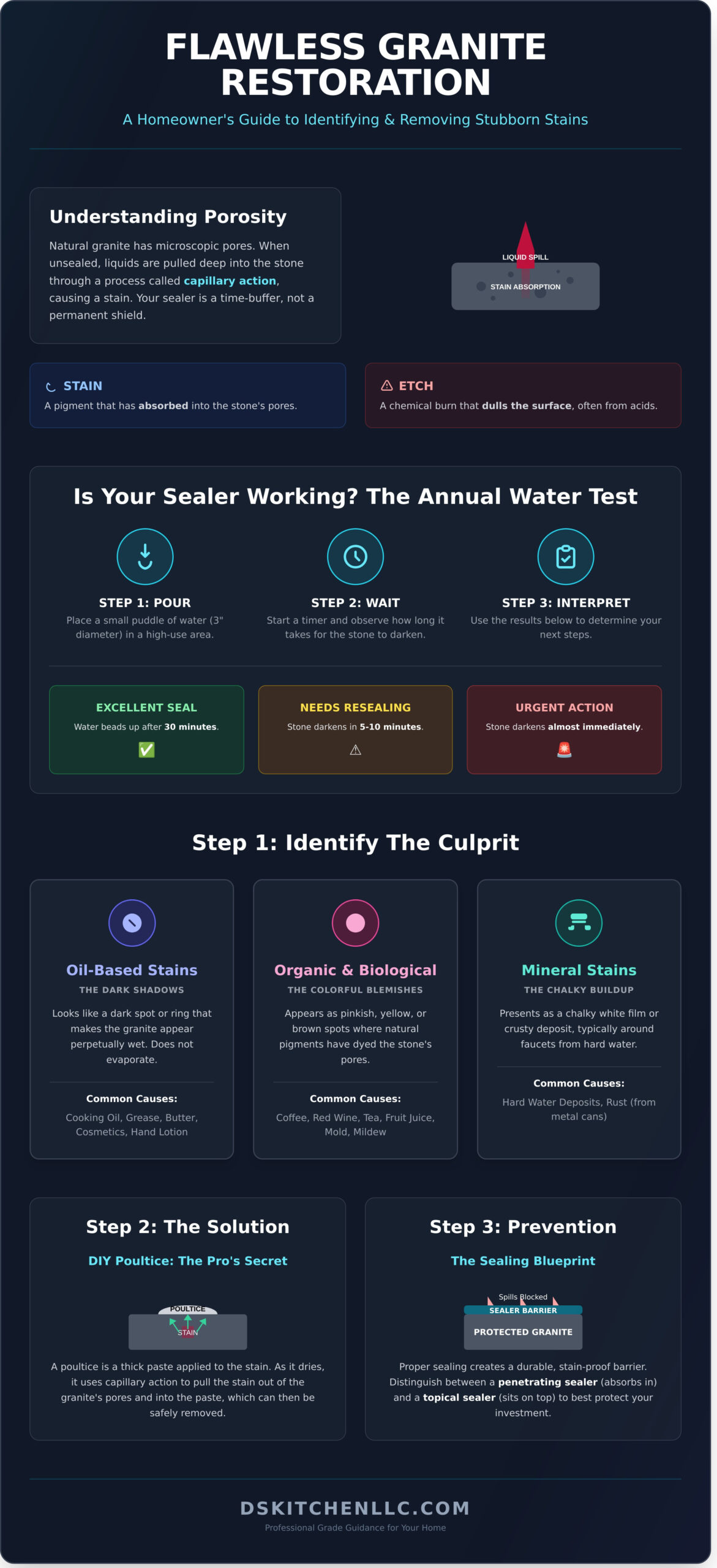
Your stunning granite countertop is a piece of natural history, formed from volcanic magma. This premium, durable material is built to last, but its natural origin means it has a crystalline structure filled with microscopic pores. Understanding this porosity is the first and most crucial step in learning how to get stains out of granite countertops and, more importantly, how to prevent them.
To see how professionals tackle common spots, this short video offers a great visual guide:
A true stain isn’t just sitting on the surface; it’s a pigment from a liquid that has penetrated deep into the stone. Your countertop’s sealant is the first line of defense. Think of it not as a permanent waterproof shield, but as a crucial time-buffer. It gives you precious minutes to wipe up spills like wine or oil before they soak in. In Tampa’s high-humidity climate, this barrier is even more critical, as constant moisture and hard water minerals can accelerate the dulling of a poorly sealed surface.
The Science of Stone Absorption
Liquids are pulled into granite through a process called capillary action. Lighter-colored granites, like Colonial White, often have a more porous structure than darker, denser stones such as Black Galaxy, making them more susceptible to staining. It’s also vital to distinguish between a true stain (absorption) and an etch. An etch is a chemical burn on the surface, often from acidic liquids like lemon juice, that dulls the finish. Understanding these core stain removal principles helps diagnose the problem correctly so you can apply the right solution.
The Annual Water Drop Test
Is your sealer still protecting your investment? This simple test provides a clear answer in minutes. Porosity is the ratio of open space within the stone’s crystalline structure.
- Step 1: Pour a small puddle of water (about 3 inches in diameter) onto your countertop, preferably in a high-use area.
- Step 2: Start a timer and watch what happens to the water.
- Step 3: Observe how long it takes for the stone to darken, which indicates water absorption.
How to Interpret Your Results: If the water beads up and is still there after 30 minutes, your seal is in flawless condition. If the stone darkens in 5-10 minutes, it’s time to schedule a reseal. If it darkens almost immediately, resealing is urgent to prevent future stains.
Identifying the Culprit: Oil, Organic, or Mineral Stains?
Before you can restore your stunning granite to its flawless condition, you must first play detective. The secret to learning how to get stains out of granite countertops is to correctly identify the stain’s origin, as different chemical makeups require completely different treatments. Using the wrong method can be ineffective or even damage your premium stone. Most granite stains fall into one of three main categories, each with distinct visual cues that help you choose the right approach.
Oil-Based Stains (The Dark Shadows)
These are some of the most common stains found in a busy kitchen. Oil-based stains look like dark spots or shadows that have soaked into the stone, making the area look perpetually wet. Because granite is porous, substances like cooking oil, butter, grease, cosmetics, or even hand lotion can penetrate the surface and will not evaporate. You’ll often see these as a dark ‘ring’ left behind by a cooking oil bottle set near the stove.
Organic and Biological Stains
Organic stains are caused by any plant or food-based material. Think of the discoloration from a spilled cup of coffee, a splash of red wine, tea, or fruit juice. These stains often appear as pinkish, yellow, or brown spots. The tannins and natural pigments in these substances essentially dye the stone’s pores. In Florida’s high-humidity climate, you may also encounter pink or black spots from mold or mildew, especially around sink areas that stay damp.
The same applies to hobbies that bring the outdoors in. For example, after a memorable trip with a charter like South Louisiana Redfishing, cleaning the day’s catch can introduce oils and liquids that also require quick attention to prevent staining.
The vibrant colors in fresh fruits and vegetables, while great for your health, are often the biggest culprits. For example, getting fresh, high-quality produce from an online grocer like Shift 2 Fresh is convenient, but it’s important to remember that even a stray berry or a splash of juice can leave a mark if not wiped up promptly.
For example, the rich, dark pigments that make a high-quality Brazilian coffee from a brand like Café Delicioso so satisfying are the same ones that can create a stubborn brown spot if not wiped up quickly.
Hard Water and Rust in Tampa Homes
If you see a chalky white film or crusty deposit, especially around your faucet, you are likely dealing with a mineral stain. In Tampa, our local hard water is rich in mineral deposits that build up over time, a process called scaling. Another common mineral stain is rust, which leaves orange to brown marks and is typically caused by metal items like cast iron pans or shaving cream cans left on a wet surface. It is critical to never use common acidic lime-scale removers on granite, as they will etch and permanently dull the stone’s beautiful finish. For more detailed guidance on creating specific cleaning solutions, the Natural Stone Institute stain removal guide offers expert-approved recipes.
The Master Guide to Granite Poultices: DIY Recipes That Work
When a surface wipe-down doesn’t cut it, a poultice is the professional-grade solution for deep-set stains. Think of it as a chemical magnet: a thick, absorbent paste is applied to the granite, and as it dries, it pulls the staining agent up out of the stone’s pores. This method is the secret to restoring your countertop’s flawless finish.
Before you begin, gather your tools: an absorbent powder (like baking soda or diatomaceous earth), a liquid mixing agent, plastic wrap, and painter’s tape. Crucial Safety Warning: Never mix cleaning agents, especially bleach and ammonia-based products, as this can create toxic gas.
The Standard Baking Soda Poultice
This simple, effective recipe is the perfect starting point for most stains. The key is matching the liquid to the stain type and achieving a paste with the consistency of thick peanut butter.
- For oil-based stains (cooking oil, grease): Mix baking soda with a small amount of water.
- For organic stains (wine, coffee, fruit juice): Mix baking soda with hydrogen peroxide.
Apply the paste generously over the stain, about 1/4-inch thick, extending slightly beyond the stain’s edges.
The 24-Hour Extraction Process
Patience is essential for this deep cleaning method. Following these steps is fundamental to understanding how to get stains out of granite countertops for good.
- Prep the Surface: Gently clean the stained area with a pH-neutral mild stone soap and water, then dry it completely.
- Apply and Cover: Spread your poultice over the stain and cover it securely with plastic wrap, taping down the edges.
- Ventilate: Poke a few small holes in the plastic wrap. This allows the liquid in the paste to evaporate slowly, which is what pulls the stain out.
- The Wait State: Let the poultice sit undisturbed for 24 to 48 hours. During this non-negotiable time, the paste will dry completely and work its magic.
Solvent-Based Poultices for Stubborn Oil
For deep, stubborn grease stains-especially those near your range-you may need a stronger solvent. Instead of water or peroxide, mix your absorbent powder with acetone or isopropyl alcohol. Apply this poultice using the same 24-hour process. Once it is bone-dry, gently scrape it off with a plastic putty knife or razor blade held at a low angle. Wipe the area clean with a damp cloth to reveal your beautifully restored granite.
Preventing Future Damage: The Sealing and Maintenance Blueprint
You’ve done the hard work of restoring your granite’s beauty. Now, let’s ensure you never have to search for how to get stains out of granite countertops again. For Florida homeowners, proactive care is not just about aesthetics; it’s the most cost-effective way to protect your premium investment. A simple maintenance plan prevents costly restoration down the road and keeps your surfaces looking flawless for years to come.
This principle of protecting a premium investment with a high-quality seal isn’t limited to home surfaces. The same logic applies to other valuable assets, like vehicles, where protective coatings are essential for maintaining a flawless finish. For those interested in how this is applied in the automotive world, Empire Auto and Detail provides a great example of using advanced sealing techniques to protect and beautify cars.
The foundation of this protection is a high-quality sealer. We always recommend a penetrating (or impregnating) sealer over a topical one. While topical sealers create a film on the surface that can dull, peel, or yellow over time, a penetrating sealer absorbs into the granite’s pores. It works from within to block liquids and oils without altering the stone’s natural look and feel.
Professional Sealing Techniques
Applying a premium impregnating sealer is a straightforward process that delivers durable protection. After thoroughly cleaning and drying the countertop, apply the sealer evenly with a clean cloth. Let it penetrate for the time specified by the manufacturer, then wipe away any excess. A properly sealed surface will cause water to bead up. For high-traffic areas, like a busy Tampa family kitchen, we recommend re-sealing every 6 to 12 months. For a detailed comparison, see D&S Kitchen LLC’s guide to the best granite sealers.
Daily Habits for Flawless Granite
Your daily routine is your first line of defense. A maintenance schedule ‘Built Around You’ and your lifestyle makes it easy to preserve your countertops. The most critical habits include:
- The ‘Blot, Don’t Wipe’ Rule: For spills like wine or oil, blot immediately with a paper towel. Wiping can spread the liquid and push it deeper into the stone.
- Use Coasters and Trivets: Protect your granite from condensation rings, heat, and acidic liquids by consistently using coasters for drinks and trivets for hot pans.
- Choose the Right Cleaner: Avoid ‘stone killers’ like vinegar, lemon juice, ammonia, or Windex, which can etch the surface and strip the sealer. Instead, use a pH-neutral cleaner specifically designed for stone or a simple mix of warm water and mild dish soap.
A simple maintenance plan is just as vital as knowing how to get stains out of granite countertops when an accident occurs. For expert advice on selecting and caring for your premium stone, visit us at dskitchenllc.com.
When DIY Isn’t Enough: Professional Restoration vs. Replacement
While DIY methods can work wonders on common organic and oil-based stains, some countertop issues go beyond surface-level discoloration. Understanding when to step back and call for expert help is key to protecting your investment. Sometimes, the most effective solution for how to get stains out of granite countertops involves recognizing that the damage requires professional equipment or that it’s time for a stunning upgrade.
Signs You Need a Stone Professional
If your efforts have stalled, look for these tell-tale signs that a professional is needed:
- The ‘Dull Spot’ That Won’t Go Away: This is likely not a stain but ‘etching’-physical damage to the stone’s surface caused by acids from things like lemon juice or harsh cleaners. Etching removes the granite’s polish and cannot be fixed with a poultice. It requires professional diamond honing and re-polishing to restore the factory shine.
- Cracks and Fissures: If a deep stain is located near a crack, it may indicate that the stone’s integrity is compromised. A professional can assess whether the stain is a symptom of a larger structural problem that needs to be addressed.
- Widespread Discoloration: For older countertops with years of accumulated stains or sealant failure, only a stone care expert with commercial-grade equipment can evenly strip, clean, and reseal the surface for a flawless finish.
This principle of knowing when to call a professional extends beyond countertops to all parts of your home’s exterior. For tough stains on pavers, decks, or roofs that DIY methods can’t handle, specialized equipment is often required. The team at PBC Pressure Cleaning are experts in restoring these outdoor surfaces, protecting your home’s overall value and curb appeal.
Upgrading Your Space with D&S Kitchen
When the cost of professional restoration starts to add up, it’s worth considering the value of a replacement. A significant repair can be an opportunity to invest in a full kitchen remodel that elevates your entire home. Today’s premium stone countertops offer far superior factory sealing technology than slabs installed a decade ago, providing enhanced durability and stain resistance from day one.
For homeowners who desire timeless beauty with zero maintenance, quartz offers a stunning and completely non-porous alternative that is virtually stain-proof. At D&S Kitchen, we believe your space should be both beautiful and functional. We provide expert guidance and a flawless installation process to ensure your new countertops are a perfect fit for your lifestyle-a solution ‘Built Just for You’.
If your granite has seen better days, let our team of seasoned craftsmen help you explore your options. Request Your Free Estimate for a Flawless Install Today and discover how a new countertop can transform your kitchen.
Restore Your Granite’s Beauty, Elevate Your Kitchen
Mastering how to get stains out of granite countertops is about understanding your stone, not just scrubbing. By correctly identifying a stain’s origin-whether it’s oil, organic, or mineral-and applying the right DIY poultice, you can restore much of your countertop’s original beauty. Remember that prevention is your strongest tool; consistent sealing and diligent daily care are the secrets to keeping your granite centerpiece flawless for years to come.
While these restoration tips work wonders, sometimes a fresh start is the best solution. If you’re dreaming of upgrading to a stunning, resilient surface, the team at D&S Kitchen is here to make your vision real. With over 10 years of expert service in Tampa, we invite you to visit our showroom and discover our collection of premium granite and quartz. We are committed to delivering a flawless installation that is truly ‘Built Around You’.
Don’t let stubborn stains diminish the heart of your home. Ready to Transform Your Kitchen with Premium, Durable Countertops? Request Your Free Estimate Today! Your beautiful, worry-free kitchen awaits.
Frequently Asked Questions About Granite Stain Removal
Can I use vinegar to clean my granite countertops if they are stained?
We strongly advise against using vinegar on granite. As an acidic substance, vinegar can damage the countertop’s sealant and even etch the surface of the stone itself, leaving a dull, hazy mark. This damage is often more difficult and costly to repair than the original stain. For safe, effective cleaning that protects your investment, always use a pH-neutral cleaner specifically formulated for natural stone to maintain its stunning finish.
How long should I leave a baking soda poultice on a granite stain?
For the best results, a baking soda poultice should remain on the stain for at least 24 hours. Cover the paste with plastic wrap and tape the edges to ensure it stays moist. This extended period allows the poultice to slowly and effectively draw the stain out from the stone’s pores. For deep-set or particularly stubborn stains, you may need to apply a second poultice to fully restore your granite’s flawless appearance.
Is it possible to permanently stain granite, or can everything be removed?
While granite is exceptionally durable, some deep oil-based stains can become permanent if left to sit for too long. Similarly, etching caused by acidic substances is physical damage to the stone and requires professional resurfacing to repair. Most common household stains from food or drinks can be removed with the correct methods. Promptly cleaning spills is the most effective way to prevent permanent blemishes on your beautiful countertops.
What is the difference between a stain and an etch on granite?
A stain occurs when a substance absorbs into the pores of the granite, causing discoloration, such as a dark spot from oil or wine. An etch, on the other hand, is physical damage to the surface of the stone. It is caused by an acid reacting with the minerals in the granite, which corrodes the surface and leaves a light-colored, dull spot. Stains can be lifted out, while etches must be professionally polished and re-honed.
How do I remove hard water rings from my granite near the sink?
Hard water rings are surface-level mineral deposits. To remove them, create a paste of baking soda and water and gently scrub the area with a soft cloth. If the deposit is thick, you can carefully use a new razor blade held at a low angle to scrape it off the surface. Once the deposit is gone, rinse the area thoroughly with water and dry it completely with a clean towel to prevent future buildup.
Does sealing my granite make it 100% stain-proof?
Sealing makes your granite stain-resistant, not stain-proof. A high-quality sealant closes the natural pores in the stone, which significantly slows down the rate of absorption. This gives you more time to wipe up spills before they can penetrate and cause a stain. However, corrosive liquids or oils left for extended periods can still seep through. Regular sealing and quick cleanups are essential for flawless protection.
Can I use bleach on white granite to get out a wine stain?
No, you should never use bleach on granite countertops, including white granite. Bleach is a harsh chemical that can strip the sealant and may react with the minerals in the stone, causing permanent discoloration or a yellowish tint. Knowing how to get stains out of granite countertops safely involves using a targeted poultice made from hydrogen peroxide and baking soda, which is far more effective and will not damage your stone.
Why did my granite stain even though I recently sealed it?
A stain can still occur on sealed granite for a couple of key reasons. The spill may have been left on the surface for too long, eventually penetrating the protective barrier. It is also possible that a lower-quality sealer was used or that it was not applied correctly, leaving areas of the stone vulnerable. A professionally applied, premium-grade sealant is your best defense against stains and ensures your countertops remain durable and stunning.