
The most expensive choice for your kitchen is often the one that makes you afraid to actually use it. While natural Carrara marble is stunning, the 40 percent higher maintenance cost and the constant need for professional sealing often turn a dream renovation into a source of daily stress. You want that timeless, elegant look for your home, but you shouldn’t have to panic every time a guest reaches for a glass of red wine. We understand that you’re looking for a surface that’s both premium and practical; a slab of quartz that looks like marble without the “fake-looking” squiggles found in lower-quality materials.
Discover how to achieve the perfect balance of luxury and durability. This 2026 guide reveals the 15 most realistic patterns available today and explains how our expert team ensures a flawless install that makes seams virtually disappear. You’ll learn exactly what to look for to ensure your new countertop is built just for you and your busy Florida lifestyle. Let’s find the high-quality stone that elevates your space while surviving everything from heavy meal prep to holiday parties.
Key Takeaways
- Understand why marble-look quartz has become the premier choice for Tampa kitchen remodels, offering the timeless beauty of natural stone without the high-maintenance upkeep.
- Learn to distinguish between bold Calacatta and soft Carrara patterns to ensure your countertop veining perfectly complements your home’s aesthetic.
- Discover how quartz that looks like marble provides the superior scratch and impact resistance needed to withstand the demands of a busy Florida household.
- Master the pro’s technique for selecting full slabs in the showroom to ensure your lighting and pattern matching meet your vision for a flawless installation.
- Explore the 2026 “full-height” backsplash trend and learn how expert seam placement creates a seamless, luxury transition from counter to wall.
The Marble Aesthetic vs. The Quartz Reality: Why Homeowners are Switching
In the Tampa kitchen remodel market, 84% of our clients for the upcoming 2026 season are specifically requesting quartz that looks like marble. Homeowners crave that classic Calacatta or Carrara aesthetic, but they don’t want the constant worry that comes with natural stone. Modern Engineered Stone is a composite material, typically made of 90 to 93 percent crushed natural quartz bound together by high-performance polymer resins. This combination creates a surface that is virtually indistinguishable from the real thing while offering superior durability for busy Florida households.
This shift isn’t just about price; it’s about lifestyle. Real marble is a metamorphic rock composed of recrystallized carbonate minerals. It’s soft and reactive. In contrast, today’s manufacturing processes have evolved significantly. We’ve moved past the era of “printed” patterns that looked like cheap pixelated stickers on a slab. Contemporary quartz features depth-integrated veining. This means the grey and gold swirls actually flow through the entire thickness of the material. If you look at the edge profile of a modern slab, the pattern continues naturally, providing a flawless look that mimics the geological layers of a mountain quarry.
The Problem with Natural Marble in Florida
Florida’s unique environment and our love for indoor-outdoor entertaining make natural marble a risky choice. Our kitchens are high-traffic zones where colorful foods and acidic drinks are constantly in play. Acid sensitivity is the primary culprit for homeowner regret. A single spilled lemon wedge or a splash of orange juice can cause “etching” in less than 12 minutes. This isn’t a simple stain. It’s a permanent chemical reaction that eats away the calcium carbonate in the stone, leaving a dull, rough spot that ruins the finish.
Porosity is another major concern. Florida’s average humidity often exceeds 70%, and natural stone “breathes,” meaning it can trap moisture and harbor bacteria if not sealed every six months. You also have to consider the “Patina” debate. Some homeowners enjoy the way marble ages and scratches over time, but most of our clients want their investment to stay pristine. If you don’t want your kitchen to look like a weathered 200-year-old Italian bakery within three years, marble might not be for you.
Quartz: The Engineered Solution
Homeowners are choosing the benefits of quartz that looks like marble because it offers a non-porous surface that never requires sealing. You can spill red wine, coffee, or hot sauce and simply wipe it away with a damp cloth. It’s a “set it and forget it” material designed for the reality of modern life. Quartz is a high-performance hybrid that combines the raw mineral strength of natural stone with the resilience of modern polymer technology.
This consistency is a major advantage during the design phase. When you choose a natural marble slab, the piece you see at the yard might have a massive “inclusion” or a dark spot that ruins your layout. With quartz, the slab you see in our showroom is the exact one that will be installed in your home. There are no surprises, no hidden cracks, and no structural weaknesses. It’s a reliable, premium product built around your specific vision for a beautiful, stress-free home.
Choosing Your Vein: Calacatta vs. Carrara Quartz Patterns
Selecting the right slab is about more than just picking a white stone. It’s about the energy the pattern brings to your home. When you browse quartz that looks like marble, you’ll find two primary “families” of design: Calacatta and Carrara. Each offers a distinct aesthetic that dictates how your kitchen feels. While one is bold and commanding, the other is soft and serene. Understanding these differences ensures your renovation is built around you and your specific lifestyle needs.
Beyond the surface, the technical construction of the slab is vital for a flawless finish. High-end quartz manufacturers now prioritize “through-body” veining. This means the intricate patterns aren’t just a digital print on top; they extend through the entire slab. This feature is essential when installing undermount sinks, as the beautiful veining remains visible on the exposed edges of the cutout. In an analysis of the Best Types Of Kitchen Countertops, experts highlight that quartz provides the luxury of marble without the constant maintenance and porous nature of natural stone.
Calacatta Look-Alikes: For the Bold Statement
Calacatta patterns are the “showstoppers” of the stone world. They feature thick, wide veins that create high contrast against a crisp white background. In 2026, we’re seeing a surge in popularity for variants like Calacatta Miraggio and Calacatta Laza. These patterns need space to breathe, making them the perfect choice for large kitchen islands or full-height backsplashes. If your island is over 72 inches long, a bold Calacatta pattern creates a stunning focal point that feels like a piece of art. These slabs pair beautifully with gold or brass hardware, which pulls out the warm “honey” or taupe undertones often found in premium Calacatta quartz.
Carrara Look-Alikes: For Timeless Elegance
If you prefer a look that’s more understated, Carrara-style quartz is your best option. It’s characterized by subtle, misty grey veining that spreads across the slab in a softer, “all-over” pattern. This style is incredibly versatile. Data from 2024 kitchen trends shows that 45% of homeowners with smaller kitchens choose Carrara patterns to avoid overwhelming the room with heavy lines. This delicate veining provides a sophisticated backdrop that won’t compete with other design elements. Carrara quartz is an excellent partner for custom cabinets in bold colors. The cool grey tones provide a crisp balance to deep navy, charcoal, or forest green cabinetry, creating a timeless look that won’t go out of style.
Color temperature is the final piece of the puzzle. While classic grey veins remain popular, 2026 trends are shifting toward warmer palettes. Patterns featuring “gold” or “sand” accents are appearing in 30% more designer portfolios this year than in 2022. Whether you choose the dramatic Statuario or the gentle Carrara, you’ll want to ensure the slab’s undertones match your flooring and lighting. If you’re ready to see how these quartz that looks like marble patterns look in person, our team can help you select the perfect slab for your next project.
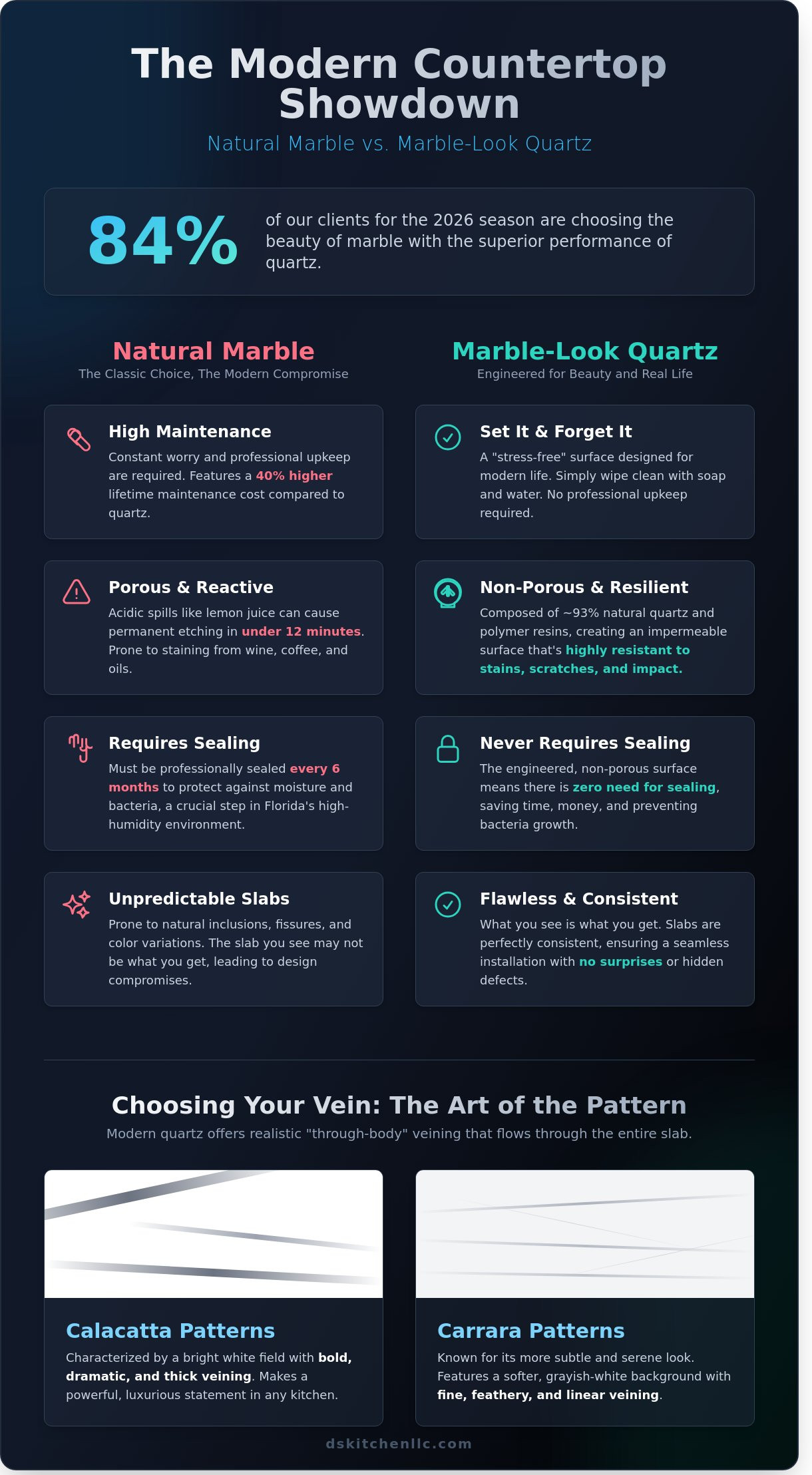
Performance in the Florida Kitchen: Marble vs. Quartz Comparison
Florida kitchens are high-traffic zones where sand, humidity, and constant entertaining put surfaces to the test. While the classic look of Carrara or Calacatta marble is a staple of luxury design, its performance often falls short for active households. Selecting quartz that looks like marble provides the same high-end aesthetic while offering a surface built for real-life use. It’s a choice that prioritizes both the “stunning” factor and the long-term health of your home investment.
The secret to this durability lies in the Engineered stone composition. Most quartz slabs consist of 93% natural quartz crystals bound with 7% high-performance resins. This creates a non-porous surface that doesn’t require the constant babying marble demands. On the Mohs scale of mineral hardness, quartz registers a 7; natural marble typically sits around a 3. This 4-point difference means your countertops won’t show the scratches or “love marks” that plague softer stones within the first 12 months of installation. While marble can handle higher heat, quartz resin remains stable up to 300 degrees Fahrenheit. You’ll still want to use trivets, but the trade-off for superior impact strength is a win for most families.
The Maintenance Comparison
Living in Florida means dealing with high acidity in the kitchen, from fresh citrus to vibrant salsas. Marble is chemically reactive; a single lemon wedge left on the surface for 15 minutes can cause permanent etching. To prevent this, marble requires professional sealing every 6 to 12 months. In contrast, quartz is virtually maintenance-free. You don’t need specialized pH-neutral cleaners or annual treatments. A simple wipe-down with soap and water keeps the surface pristine. Because it’s non-porous, quartz also prevents the growth of bacteria and mold, which is a significant advantage in our humid climate.
- Stain Testing: In head-to-head tests, red wine and coffee left overnight on quartz wipe away without a trace. On unsealed marble, these liquids penetrate the stone within 30 minutes.
- Daily Care: Quartz requires zero specialized chemicals, saving you roughly $60 a year on dedicated stone cleaners.
- Hygiene: The non-porous nature of quartz makes it an NSF-certified surface for food preparation.
Cost and ROI for Florida Homeowners
When you look at the countertops market in Tampa, you’ll find that premium marble-look quartz often carries an upfront price tag of $75 to $150 per square foot. This is comparable to mid-grade natural marble. However, the real savings appear in the lifetime value. A marble countertop often requires professional restoration every 3 to 5 years to remove scratches and stains, costing $500 or more per visit. Quartz eliminates this recurring expense entirely. For Tampa homeowners looking to sell, a quartz kitchen often adds 5% to 7% more to a home’s appraisal value because the material stays in “like-new” condition regardless of how many years it’s been in use. It’s a smart, results-driven choice for those who want a flawless look without the high-maintenance lifestyle.
The Pro’s Guide to Selecting Slabs in the Showroom
You’ve done the online research and narrowed down your favorite brands. Now it’s time to see the stone in person. Selecting quartz that looks like marble requires a different strategy than picking a solid color. A 4-inch sample simply cannot capture the organic movement or the scale of a 126-inch by 63-inch slab. You need to see the “flow” of the veins to ensure they don’t look cramped or artificial when stretched across your specific countertop layout. At D&S Kitchen LLC, we’ve spent 10 years guiding homeowners through this process to ensure the final result looks like a premium natural stone rather than a printed imitation.
Lighting is your most important tool during a showroom visit. Most warehouses use 5000K “daylight” LEDs, which are very bright and blue-toned. However, your kitchen might use 3000K “warm” bulbs. This difference can make a “crisp white” slab look yellow or dingy once it’s installed in your home. Ask the staff to move the slab near a loading dock or a window if possible. This allows you to see the material under true natural light. You should also evaluate the finish under these lights. While a polished finish offers a classic high-gloss shine, a honed finish provides a matte, soft appearance. If you want something unique, ask to see “suede” or “leathered” finishes. These provide a subtle texture that mimics the feel of aged European marble.
Be a detective when inspecting the surface. Look closely for “resin pools.” These are small, concentrated clusters of pigment or binder that look like dark ink blots or smudges. While 98% of premium slabs are flawless, these occasional manufacturing artifacts can be an eyesore if they land in the center of your island. You should also check for pattern repetition. If your project requires three slabs, verify that the veining varies enough so your kitchen doesn’t look like it was covered in repeating wallpaper. High-quality manufacturers randomize the print to avoid this “stamped” look.
What to Bring to Your Visit
Never show up to a showroom empty-handed. Bring your actual cabinet door sample. A “cool” white quartz that looks like marble against “creamy” white cabinets will look like a design mistake. You want the whites to harmonize, not fight. Bring your floor tiles too. You need to ensure the grey, gold, or charcoal undertones in the quartz veining complement your flooring. Finally, bring photos of your current space. This helps our experts suggest the right scale for your pattern. A massive, bold vein might look stunning on a 10-foot island but could look cut-off or awkward on a small 24-inch vanity.
Evaluating Slab Quality
Lower-quality quartz often suffers from “pixelation” in the print. If you look closely and see tiny dots or jagged lines instead of smooth, fluid veins, the print resolution is too low. For homeowners designing a large island or a full-height backsplash, ask about book-matching. This is where two slabs are manufactured as mirror images. When joined at the seam, the veins flow perfectly from one piece to the other, creating a high-end, custom look. You can book an appointment at our Tampa showroom to see these premium slabs in person and compare different veining styles side-by-side.
Flawless Installation: Bringing the Marble Look to Your Tampa Home
Selecting the perfect slab is only half the journey. The real magic happens during the installation phase, where raw material transforms into a centerpiece. Many homeowners in Florida are now choosing quartz that looks like marble for their renovations because it offers the high-end aesthetic of Carrara or Calacatta without the constant worry of staining. However, the illusion of natural stone depends entirely on the skill of the installers. If the veins don’t line up at the seams, the sophisticated look is lost instantly.
At D&S Kitchen, we believe every project should be “Built Around You.” This means we don’t just drop a slab onto your base units. We treat your kitchen as a unique architectural puzzle. With over 10 years of experience serving the Tampa Bay area, we’ve developed a workflow that prioritizes pattern matching and structural integrity. Our goal is to ensure that the sweeping grey or gold veins of your quartz flow across your counters as if they were carved from a single block of earth.
The Installation Process
Digital precision is the foundation of a great kitchen. We use advanced laser templating to map your kitchen’s layout with a 0.01-inch tolerance. This technology allows us to account for walls that aren’t perfectly square and ensure a snug fit against your custom cabinets. By capturing these measurements digitally, we can plan exactly where each vein will sit before we ever make a cut.
The mitered edge is a favorite technique for those seeking a luxury feel. While most quartz slabs are 2cm or 3cm thick, a mitered edge allows us to join two pieces at a 45-degree angle. This creates the appearance of a massive, 3-inch thick marble block. It’s a powerful way to add weight and presence to a kitchen island. To keep the look seamless, our team uses color-matched epoxy resins. We hand-mix these adhesives to match the specific background hue of your slab, making joins nearly invisible to the eye.
Looking ahead to 2026 design trends, the “Full-Height” quartz backsplash is becoming a standard for premium homes. Instead of using traditional tile, we extend the countertop material all the way up to the bottom of the upper cabinets. This creates a continuous “waterfall” of stone. It eliminates grout lines and makes the beauty of quartz that looks like marble the undeniable focal point of the room. It also makes cleaning much easier, as there are no porous joints to scrub.
Edge profiles play a significant role in the final character of your kitchen. We offer several options to mimic traditional marble craftsmanship:
- Ogee: A classic, “S” shaped curve that adds a touch of traditional elegance.
- Mitered: The best choice for a bold, thick, modern appearance.
- Eased: A clean, slightly rounded edge that feels contemporary and stays out of the way.
Completing the Transformation
Your choice of sink serves as the final anchor for your new countertops. An undermount stainless steel sink provides a sleek, professional look that highlights the polished edge of the quartz. If you prefer a more classic aesthetic, a white farmhouse sink pairs beautifully with marble-patterned stone to create a timeless “Cottagecore” or “Modern Farmhouse” vibe.
Before our team finishes, we conduct a final walkthrough with you. We inspect every corner to ensure the vein flow is natural and the surfaces are flawlessly polished. We want you to feel the same confidence in our work that we do. Ready to elevate your space with a durable, stunning alternative to natural stone? Contact D&S Kitchen today for your free marble-look quartz estimate and let’s start building a kitchen that’s truly yours.
Bring Your 2026 Kitchen Vision to Life
Your dream kitchen shouldn’t come with a constant list of maintenance chores. Choosing quartz that looks like marble allows you to enjoy the iconic grey veining of Carrara or the bold drama of Calacatta without the 6-month sealing cycles required by natural stone. In the humid Florida climate, quartz provides a non-porous surface that resists stains and bacteria better than traditional marble. We’ve spent 10+ years delivering remodeling excellence across Tampa, ensuring every countertop is both stunning and functional.
At D&S Kitchens, we believe your home should be built around you. Our experts guide you through the slab selection process at our Armenia Ave showroom, where you can inspect the premium patterns and textures in person. We pair this personalized service with our Flawless Installation Guarantee to ensure your renovation exceeds every expectation. You don’t have to sacrifice style for durability when the right materials and expert craftsmanship are just a visit away. We’re ready to help you create a space that stays beautiful for a lifetime.
Schedule Your Free Design Consultation & Estimate
Frequently Asked Questions
Does marble-look quartz actually look real?
Modern manufacturing uses advanced 3D inkjet printing to replicate natural stone with incredible accuracy. These slabs consist of 93% natural quartz minerals, which helps them retain the heavy feel and cool temperature of genuine marble. You’ll find that premium slabs produced after 2024 feature deep, realistic veining that flows through the entire thickness of the stone rather than just sitting on the surface.
Is quartz more expensive than real marble?
Quartz is generally more cost-effective than high-grade natural marble. While rare Calacatta marble can cost over $200 per square foot, premium quartz that looks like marble typically ranges from $60 to $120 per square foot installed. This price difference allows you to achieve a luxury look while staying within a predictable budget for your kitchen renovation.
Can you put hot pans on marble-look quartz countertops?
You should never place hot pans directly on a quartz surface. Even though quartz resists heat up to 300 degrees Fahrenheit, the resins used to bond the stone can discolor or crack when exposed to higher temperatures. Always use a trivet or heat pad for any cookware coming off a 450-degree stove to protect your investment and prevent permanent thermal shock.
What are the best quartz brands for a marble look in 2026?
Cambria, Silestone, and Caesarstone remain the industry leaders for realistic marble aesthetics heading into 2026. Cambria is known for its bold Brittanicca series, while Silestone’s Ethereal collection uses specialized technology to create sophisticated, airy veining. These manufacturers offer 25-year warranties, giving you peace of mind that your stunning kitchen is built to last for decades.
Does quartz that looks like marble stain?
Quartz is highly resistant to staining because it’s a non-porous material. It has a water absorption rate of less than 0.05 percent, meaning liquids like red wine or coffee won’t soak into the surface and leave permanent marks. Unlike natural marble, you don’t have to worry about acidic foods like lemons etching the finish or causing dull spots during meal prep.
How do I clean and maintain my marble-look quartz?
Cleaning your countertops is simple and only requires mild dish soap and a soft microfiber cloth. You don’t ever need to seal, wax, or buff quartz because the non-porous surface is permanent. Avoid using harsh chemicals like bleach or abrasive scouring pads, as these can eventually dull the factory polish. A quick daily wipe keeps the stone looking flawless with almost zero effort.
Can I use quartz as a full-height backsplash?
You can definitely install quartz as a full-height backsplash to create a seamless and modern aesthetic. This design choice removes the need for grout lines, which makes your cooking area significantly easier to sanitize and maintain. We often use 2-centimeter slabs for backsplashes to ensure a perfect color match with your 3-centimeter countertops, resulting in a stunning and cohesive look.
Is it better to get a polished or honed finish for a marble look?
A polished finish is the most popular choice because it mimics the classic, high-gloss shine of traditional Italian marble. Polished surfaces reflect about 85% of light, which helps brighten your kitchen and makes the veining patterns pop. If you prefer a softer feel, a honed finish offers a matte look that’s excellent at hiding fingerprints, though it may require more frequent wiping to remove oil spots. These principles apply to bathrooms as well; for examples of how these finishes work in different spaces, check out Countertops and Cabinetry By Design.